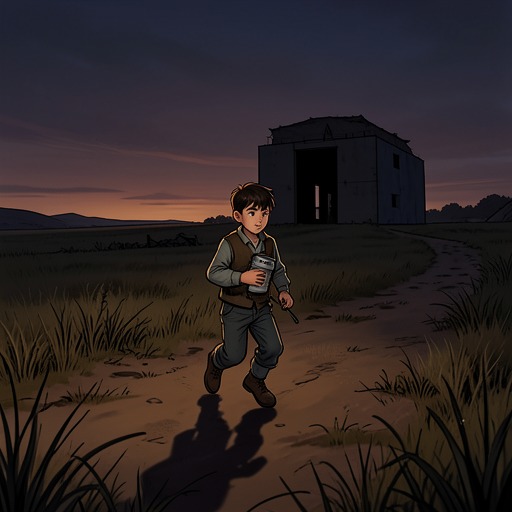
Lude
House of LeavesLude is Johnny Truant’s closest and most consequential friend in the opening movement of the narrative: a vulgar, restless presence whose late-night summons lead Johnny to Zampanò’s abandoned apartment and therefore to the manuscript that reorganizes his life. He embodies sociability and appetite in contrast to Zampanò’s isolation, yet his own fear of ending up alone gives that appetite an unexpectedly tragic depth.
Identity and Social Character
Lude is presented through Johnny’s recollection as someone who resists solitude with jokes, drinking, parties, and constant motion. He once described an eighty-year-old man living alone as the fate he dreaded, emphasizing the absence of a wife, children, or even a single friend. The confession is immediately undercut by Lude’s attack on Johnny’s own precarious life: he mocks Johnny for working in a tattoo shop and falling for a stripper named Thumper. The exchange establishes Lude’s characteristic mixture of insight and cruelty. He recognizes the terror of abandonment, but expresses recognition through profanity, teasing, and deflection rather than through solemn sympathy.
Lude’s social energy also explains why Johnny answers his call when anyone else might have been dismissed. Johnny identifies Lude as a good enough friend to justify dragging himself out of bed at three in the morning. Lude’s real name may be Harry, but Johnny notes that nobody he knows calls him that, making “Lude” the name by which his social identity is actually constituted. The alias suggests a persona built for movement and performance rather than domestic stability.
The Summons to Zampanò’s Apartment
Lude’s decisive action is waking Johnny at three in the morning to inspect the belongings of a dead man. The immediate circumstances are practical and opportunistic: after Zampanò’s death, the landlord posted an abandonment notice, judged the apartment’s contents worth less than three hundred dollars, and arranged for charity workers to remove them. Lude discovers the situation before the workers arrive and brings Johnny to the building.
The invitation initially resembles one of Lude’s ordinary nocturnal excursions. Johnny explains that Lude typically calls late at night because he wants to attend a party, and describes him as the sort of person who treats drinking and nightlife as a permanent mode of existence. Yet the destination transforms that familiar pattern. Lude waits outside the gate with a wicked gleam, unlocks the entrance, and leads Johnny through a hallway whose rattling keys, shrieking hinges, damp shadows, and dim lamps make the building feel less like a crowded residence than a crypt. He whispers as he shares information, and the remembered details acquire the force of warnings only after the fact.
Johnny later sees the journey as an irreversible passage. He imagines himself being pulled forward by inertia and curiosity, past sleeping tenants sealed behind sturdy doors, toward the last door on the left. Lude’s seemingly casual invitation thus becomes the first human action in the chain that connects Johnny to Zampanò’s papers. His role is not merely to provide access to a setting; he converts abandoned property into an opportunity and makes Johnny’s encounter with the manuscript possible.
Friendship and Contrast
The friendship between Lude and Johnny is marked by familiarity strong enough to survive irritation, mockery, and inconvenience. Johnny gets out of bed because Lude calls, even though he immediately recognizes that he should have suspected a trap or at least sensed that the night carried consequences. Lude’s ability to recruit Johnny depends on this trust, but the same trust also exposes Johnny to the dangers he cannot yet perceive.
Their relationship is comic in surface form and asymmetrical in consequence. Lude sees the night as an adventure involving a dead stranger’s possessions; Johnny becomes the person burdened by the apartment, the manuscript, and the memories attached to them. Lude’s jokes about Johnny’s sexual and economic life further establish him as a friend who uses intimacy as license to provoke. At the same time, his fear of dying without meaningful human ties places him beside Johnny in a shared condition of instability. Lude wants companionship, but the evidence shows him pursuing it through restless episodes rather than through the lasting structures he claims to desire.
Lude also functions as a sharp counterpoint to Zampanò. Zampanò is remembered as having no family, no friends, and hardly any money; Lude, by contrast, is defined by calls, parties, drinks, and a friend willing to follow him into an abandoned apartment. The contrast is not simply between isolation and sociability. Lude’s fear of becoming like the old man suggests that social abundance may itself be a defense against the same emptiness. His liveliness keeps loneliness at bay, but it does not guarantee permanence.
Death and Retrospective Meaning
The later entry dated October 25, 1998, states with stark brevity that Lude is dead. The announcement is followed by Johnny’s disorientation, vertigo, and sense of loss, as if the fact has destabilized both his present and his ability to look backward. This ending changes the emotional meaning of the earlier scenes. Lude’s three-o’clock call is no longer only the beginning of an ominous adventure; it becomes one of the surviving traces of a friend whose own fear of ending up alone has been fulfilled in a different and more final form.
His death also turns Lude’s joking sociability into a form of dramatic irony. The man who feared having no wife, children, or friends is remembered through the friend he awakened and the chain of events he set in motion. Yet the text does not offer a complete account of his death in the supplied material. What it does reveal is the abruptness of Johnny’s encounter with the fact: the declaration is isolated, dated, and followed by a collapse in temporal orientation. Lude’s disappearance therefore becomes not only a biographical loss but also a fracture in the narrative’s ability to proceed normally.
Narrative Function and Significance
Lude is the hinge between ordinary nightlife and the uncanny archive of Zampanò. His motives remain grounded in recognizable impulses—friendship, curiosity, opportunism, and the desire to avoid isolation—but the consequences exceed anything he appears to anticipate. Through him, the story moves from the social world of parties and drinks into the abandoned apartment, where objects belonging to the dead become the source of a manuscript and a new narrative burden.
His characterization is deliberately episodic. A late-night phone call, a walk through a dark hallway, a few drinks, a crude joke, and finally a dated notice of death are separated by the larger architecture of the book, yet together they create a compact arc from invitation to absence. Lude’s importance lies precisely in this disproportion: he appears as a marginal, irreverent friend, but his actions initiate Johnny’s central inheritance, while his death retrospectively makes every earlier act of companionship feel precarious. He is both the guide into the story and one of the people the story leaves behind.